

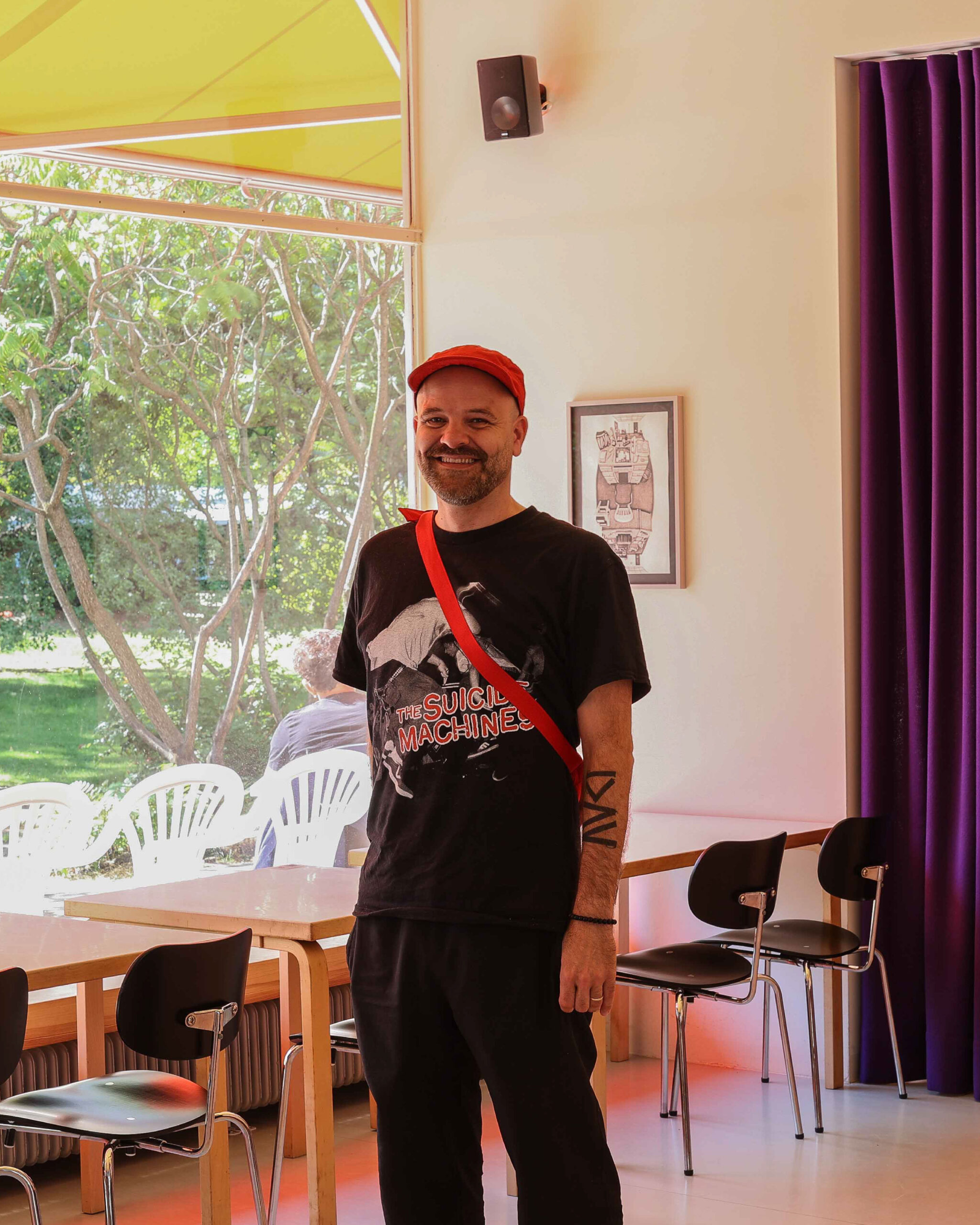
Bob (43) from Berlin has been wearing a Kaleido insulin pump for two years. Before that he had a tubed pump, before that a pen – and in between, quite a long stretch when he’d simply had enough of pumps. Today he’s glad he gave it another try. “The therapy definitely gives me flexibility in life,” he says, “and in a big way.”
Bob was diagnosed with type 1 diabetes 14 years ago, at 29. He still remembers that time clearly: he was just moving in with his girlfriend at the time and was in the middle of the final exams for his training as a market and social researcher. “Suddenly my vision was bad, I was always thirsty – classic symptoms.” It was his mother who first suspected something. “She said: Look, you’re thirsty all day long, I have a bad feeling about this.”
What bothered him most afterwards was that he could no longer live his everyday life as spontaneously as before. “I was always very happy not making a lot of plans and deciding things on the spur of the moment,” he says. This was especially noticeable when it came to food: he preferred not to eat anything after 6 p.m., because otherwise he would wake up at night between two and four. His best friend lives in Barcelona, where restaurants haven’t even opened yet at that time.
First a pen, then a pump, then back to the pen
For the first two to three years, Bob injected with a pen. After that he got his first insulin pump, a tubed model that he wore on his belt. When this pump failed during a band tour, it turned into quite an ordeal: first to the hospital, then searching for a pharmacy. “That almost cost us a whole day of the tour.” After that, he initially went back to the pen.
That only changed when the first hybrid closed-loop systems came along. “When the whole loop thing became better known and bigger, it was clear to me that I wanted something like that.”
The tip came from his diabetologist
Bob talked to his diabetologist about pumps. He couldn’t decide between a patch pump and a tubed pump. “She said: Oh, wait a moment, there’s a product coming onto the market right now. Just wait six months.” She got back in touch when Kaleido became available. In summer 2024, Bob made the switch – relatively soon after the market launch.
Patch or tube – both are possible
That was exactly what tipped the scales for him. Bob didn’t know beforehand which way of wearing it would suit him, and with Kaleido he didn’t have to commit: the same pump can be worn as a patch directly on the body or with tubing in a pocket.
“I wasn’t sure whether to go for a patch or a tubed pump, and this gave me the flexibility,” he says. “For me, that’s definitely the standout feature.”
These days he almost always wears it as a patch – something he only figured out in everyday life. He still uses tubed mode depending on what he’s planning. “Especially when running, it’s cool that I don’t have to think about it and just have it in my pocket. And the other way round, when I’m walking around at home, it’s also cool that I can get past door handles without my pump getting ripped off.”
Small and light in everyday life
One difference from his old pump particularly stands out to him: “It’s small and light.” He wore the previous one on his belt, with a long tube – “like some kind of device.” He wears his Kaleido in black; the choice of colour was never the deciding factor for him.
Because Bob needs a lot of insulin throughout the day, he changes the reservoir every two to three days. For him, that’s not an argument against the pump. “Every two or every three days – it really doesn’t matter anymore.”
“Suddenly that works now”
The biggest change for Bob came from the DBLG1 algorithm that his Kaleido pump works with. He still remembers the first day after being set up: he went to eat at Magic John’s Pizza, a place in Berlin he highly recommends. Afterwards, his curve looked as if it had been drawn with a ruler. “Suddenly that works now.”
Before, the same meal would have meant constantly keeping an eye on his levels and injecting corrections. “Now I just enter the number and DBLG1 does the maths. That’s great.” About the system, he says: “That was the game changer. And it still is.”
Nights have changed too. “I very rarely wake up at night now.” And in the evenings, things are possible again that weren’t for a long time. “I just head out and eat pizza,” he says. Or he’s out with friends at midnight, everyone grabs something to eat, and he joins in. “Basically, I eat what I want to eat.”
Modes for festivals and sport
Bob regularly uses the pump’s different modes. At festivals he switches on Zen mode together with Physical Activity mode, and then only needs to check briefly every few hours. When snowboarding, with an overnight stay at 2,000 metres, he reduced his insulin by 30 percent.
“I use settings like that and like to play around with them,” he says with a laugh, “but then I immediately forget what I did.”
Less luggage, always three plans
What Bob carries with him when he’s out and about has also changed. A large pack of syringes used to be part of his travel kit. Today he carries a red bag that always contains the same things: sugar, a power bank and syringes for emergencies.
Still, he sticks to his basic principle. “I always need three plans – that’s my golden rule. Plan A is the pump, plan B is the syringe, and plan C is: I go home and recharge there.” The difference is that today, plan A handles most of it on its own.
By the way, there’s something else on his list: surfing. And a hike across the Alps, starting somewhere near Salzburg and coming out somewhere near Ljubljana.